Social Skills
Teaching
Social Skills
Like many other skills, social skills for children with Autism
must often be taught directly. This is because children with
autism do not easily acquire those skills naturally from their
environment, like their typically developing peers. It is
also because autistic children have greater difficulty reading
subtle social cues, which makes interpreting meaning challenging.
Teaching social skills directly can take many forms. For
example, in addition to video
modeling, using a method called Applied Behavior
Analysis (ABA) is often successful. ABA involves breaking
down a task into its component parts to teach it and using
positive reinforcement to motivate the desired behavior.
NEW! Social
skills curriculum resources
Applied Behavior
Analysis (ABA) and Autism
ABA is a method of teaching children with Autism Spectrum
Disorder. ABA requires anywhere from 30-40 hours per week
of one-to-one teaching. Each skill is broken down into its
component parts and taught in a structured teaching environment.
Appropriate behavior is rewarded, and inappropriate behavior
is redirected or ignored.
Teaching social skills with ABA requires multiple trials
of the same target. Only once a skill is mastered is a new
target introduced.
Methodical records are kept of each teaching trial to assure
mastery of a target. The data is reviewed by a behavior consultant
who oversees the program. From the data, the consultant may
decide to hold off on targets, put the target on a maintenance
schedule, or introduce a new target.
The Model Me Kids videos are a useful teaching tool
in combination with an ABA program for setting and teaching
social skills targets.
Social Skills
and School Inclusion
Social skills are important for inclusion in the classroom.
Inclusion in a school environment with typically developing
peers is often not dependent solely on a child's IQ or intelligence.
Children with Autism and Asperger Syndrome are often capable
of working at grade level, but are at risk of not being included
in a classroom because of behavioral issues or poorly developed
social skills.
Social Skills
Groups
Social skills groups may be found through community organizations.
Many schools also offer social skills groups that take place
during the school day within the context of school. This type
social skills group may require an IEP in order for the child
to participate. The purpose of a social skills group is to
teach and guide social interaction of the children participating
in the group so as to teach them how to establish and maintain
friendships.
|
|
Social Skills
Training Videos
Autism
& Asperger's DVDs

|
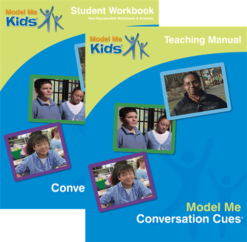
Model Me Conversation Cues®
Models nonverbal cues, how and when to start
a conversation, maintain conversation, turn-taking in
conversation, & more.
Run
Time: 68 min.
DVD plus free photo CD
For Ages 9-17
read more | order
|
 |
|
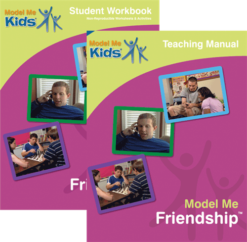
Model Me Friendship
Models social skills involved in initiating
and maintaining a friendship including: compromise, invite, handling rejection,
team sports, empathy, and more.
Run Time: 75
min.
DVD plus free photo CD
For Ages 9-17
read more | order
|
 |
|
Model Me Tips & Tricks
Models social skills such as using tact,
appropriate voice modulation, good hygiene, asking for help, sense of
humor, and more.
Run Time: 67
min.
DVD plus free photo CD
For Ages 9-17
read more | order
|
 |
|
Model Me Confidence & Bullying Prevention
Models skills for building confidence and preventing bullying through
self-advocacy, choosing friends, positive self-talk, and more. Bonus DVD
on bullying geared toward parents, schools, and therapists, featuring
Asperger's guru Nick Dubin.
DVD, bonus DVD, plus free photo CD
For Ages 9-17
read more | order
|
 |

|
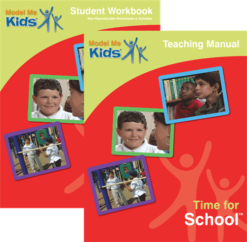
Time for School
Topics include: listen to the teacher, share, sit quietly, take turns,
show interest in others, playground, & more.
Run Time: 61 min.
DVD plus free photo CD
For Ages 5-12
read more | order
|
 |
|
Time for a Playdate
Topics include: greet friend, losing, answer,
play his way, eye contact, clean up, say goodbye & more.
Run Time: 67
min.
DVD plus free photo CD
For Ages 5-12
read more | order
|
 |
|
I Can Do It!
Models appropriate behavior in stressful
situations, including waiting, transitions, birthday parties, handling
criticism, & more.
Run Time: 53
min.
DVD plus free photo CD
For Ages 5-12
read more | order
|
 |

Music Therapy Meets Video Modeling:
|
Model Me Faces & Emotions
Demonstrates emotions and facial expression
including happy, sad, tired, bored, & more.
Narrated with
songs by Music Therapist Rachel Rambach, MM, MT-BC.
Run Time: 27 min.
DVD plus free photo CD
For Ages 2-8
read more | order
|

|
|
Model Me Going Places
Models appropriate behavior in community
locations including the hairdresser, grocery store, dentist, doctor, mall,
and more.
Narrated with
songs by Music Therapist Rachel Rambach, MM, MT-BC. Free supplementary
iPhone/iPod app featuring locations from the DVD.
Run Time: 42 min.
DVD plus free photo CD
For Ages 2-8
read more | order
|

|

Teaching Manuals & Student Workbooks (Home and
School)
The DVDs may be purchased alone. We also offer extra teaching
resources for use with the DVDs: A teaching manual with lesson
plans and progress charts. A social skills workbook with worksheets
and activities. These may be used by parents in the home or
by teachers/therapists in an educational setting.
Teachers: Use to build a social skills curriculum.
Parents: Reinforce skills presented in the videos.
Sold separately from DVDs.
Currently Available:
Time for School Teaching Manual:
132 non-reproducible pages, softcover
Time for School Student Workbook: 132 non-reproducible
pages, softcover.
Model Me Conversation Cues Teaching Manual: 120
non-reproducible pages, softcover.
Model Me Conversation Cues Student Workbook: 140 non-reproducible pages,
softcover.
read more | order
Using Positive
Reinforcement to Teach Social Skills
Reinforcing appropriate behavior is one way to promote acquisition
of social skills. When the desired behavior is exhibited,
immediate reward will reinforce the behavior and make it more
likely to occur again in the future. For example, the child
is asked to greet a friend at the door at the beginning of
a playdate. The child says "hello." Immediately,
a pat on the back or "good job saying hello" whispered
in the ear is given to reward the appropriate social interaction.
Examples of types of reinforcement include:
|