
MM Confidence & Bullying Prevention™
Autism Bullying
Model Me Confidence & Bullying Prevention™ is a teaching tool for preventing bullying and building self-esteem at school and beyond.
Elementary, Middle School, High School
Run Time: Approx. 63 Min.
Watch Preview
Model Me Confidence & Bullying Prevention™
Topics
Self-Advocacy
Peer Pressure
Choosing Friends
Building Strengths
Visualization
Positive Self-Talk
Scripting
Stay With Others
Telling Isn’t Tattling
Walk Tall
Group Discussion: children share experiences of being picked on and how they handled it.
Manuals/Workbooks
Autism Bullying
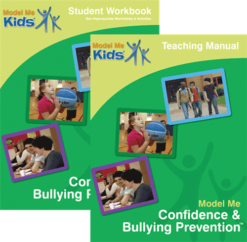
The teaching manual and student workbook for this video promote learning through adaptable lesson plans paired with visual exercises. These resources support skill acquisition in the classroom, at home, and in the community.
Out of stock
About
School psychologist and curriculum developer Dr. Erica Edelman writes the following in the introduction to the corresponding Teaching Manual:
Talking About Bullying
Bullying is happening every day in every school in every corner of the world. What is bullying? Moreover, how do you know whether you are being bullied? Furthermore, what can you do about it?
Bullying happens when a student is harmed, again and again, by another person or group of people. There is almost always a difference in power between the bully and the victim; the bully usually has greater physical or psychological strength than the victim.
Bullying can come in the following forms: hitting, kicking, destroying property, teasing, name-calling, using racial or religious slurs, excluding someone from a group, spreading rumors and sending false or threatening emails or messages.
Bullying is not a regular part of growing up. It is a very serious problem. If you are the subject of bullying and you don’t get help, you may become very sad, worried and down on yourself.
If someone is bullying you, there are trusted adults who can help you. Talk to your parents, teacher, guidance counselor, clergy, or coach is not tattling; it is problem-solving. Moreover, it is not your fault that you are being bullied. Don’t try to handle this all by yourself.
Model Me Confidence & Bullying Prevention™ will give you some good ideas about how to make yourself as strong as you can be. The lessons will give you ideas for filling your toolbox with a variety of tools to use every day at school, at home, and in your community. Then, if a bully appears in your corner of the world, you will be able to pull out strategies that work and you will know just what to do.
– Erica Edelman, Ph.D.
Dr. Erica Edelman
Dr. Edelman received her B.S. from Cornell University, her M.A. from Tufts University, and a Ph.D. from the University of Maryland School of Psychology. She has worked as a staff psychologist at Kennedy Krieger Institute (Johns Hopkins Hospital) with children with neurodevelopmental disorders. Since 1991, Dr. Edelman has worked for the public school systems conducting evaluations, engaging in differential diagnosis, overseeing intervention plans, advocating for children’s rights, training psychology interns, collaborating with interdisciplinary teams, counseling staff and families. For the past 11 years, she has specialized in working with young children with complex developmental disabilities including autism spectrum disorders, sensory difficulties, communication disorders, and learning disorders within an early intervention program setting. In addition, Dr. Edelman maintains a private practice focused on psychoeducational evaluation of young children with special needs.
Shop