
MM Conversation Cues™
Autism | Aspergers
Model Me Conversation Cues™ presents middle and high school-aged children demonstrating how to read verbal and nonverbal social cues so that students can understand the nuances of communication in any environment.
Elementary, Middle School, High School
Run Time: Approx. 68 Min.
Watch Preview
Model Me Conversation Cues™
Topics
When To Start Conversation
Interested
Not Interested
How To Start Conversation
Bored
Take Turns
Maintain Conversation
Talk on Topic
Disbelief
Confused
My Cues
End Conversation
Manual & Workbook
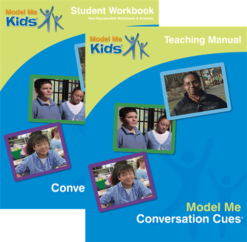
The teaching manual and student workbook for this video promote learning through adaptable lesson plans paired with visual exercises. These resources support skill acquisition in the classroom, at home, and in the community.

Challenge
One of the significant challenges for individuals with Autism involves difficulties in understanding and interpreting social cues.

Skills
Reading various social cues (interested, bored, etc.) are important for individuals with Autism to develop, as they play a crucial role in effective social interactions.

Benefits
Being able to read social cues is immensely beneficial, as it facilitates improved communication.

Video Modeling
Video modeling teaches skills designed to enhance social cue recognition in individuals with Autism and Aspergers.
Autism & Aspergers
Aspergers syndrome, once considered a distinct diagnosis but now often included under the broader term autism spectrum disorder (ASD), is characterized by unique patterns of behavior and communication. Individuals with Asperger’s typically exhibit intense interests, exceptional memory, and challenges in social interactions. While they may excel in specific areas, they often struggle with understanding social cues and maintaining reciprocal conversations.
Unlike classic autism, individuals with Asperger’s usually do not experience significant delays in language development. Though no longer a separate diagnostic category, the term “Aspergers” is still used colloquially to describe individuals on the higher-functioning end of the autism spectrum.
Recognizing and understanding the unique strengths and challenges associated with Aspergers is crucial for providing tailored support and fostering an inclusive and accepting society.
Aspergers and Autism Cues
Social cues play a pivotal role in communication and relationships, and for individuals with autism, understanding these cues is vital. Challenges in interpreting facial expressions, body language, and tone of voice can hinder effective social interactions. Addressing these difficulties through targeted interventions fosters improved social communication, enhances relationships, and promotes inclusivity, contributing to the overall well-being and success of individuals with autism in various social contexts.
Shop